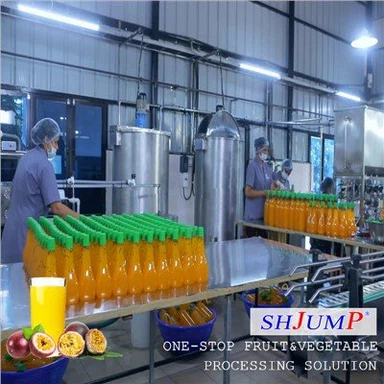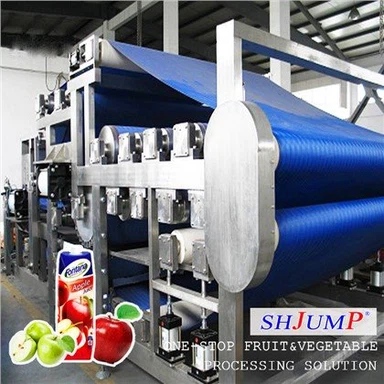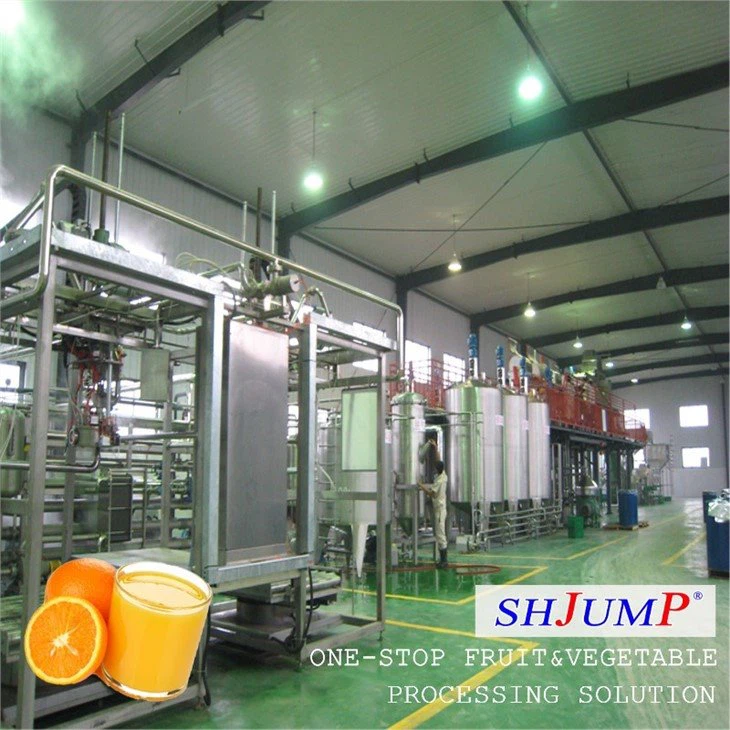


Orange Juice Processing Line
These are commercial squeezed orange juice that is pasteurized and filtered before being evaporated under vacuum and heat. After most of the water is removed, it is concentrated and then stored as about 10 degrees Fahrenheit. With this process, vitamin C, essences, and oils are extracted and are added back after to restore flavor and nutrition.
- Fast Delievery
- Quality Assurance
- 24/7 Customer Service
Product Introduction
Shanghai Jump Machinery & Technology Co., Ltd. is one of the most reliable manufacturers and suppliers of orange juice processing line in China. Please feel free to buy advanced orange juice processing line made in China here from our factory. Quality products and reasonable price are available.
1. Project Overview
|
Raw material |
Fresh orange, lemon,etc |
|
Finished product |
Concentrated Juice, NFC Fresh Nature Juice,Oil,Orange pulp |
|
Processing capacity |
From 20tons/day to 2000 tons/day |
|
Efficient input |
45% raw fruit (55% as waste, peels and seeds) |
|
Fruit consistence |
7-12 Brix |
|
End package |
Aseptic bag/tin can/glass bottle/PET bottle |
|
Output |
Can be calculated |
2. processing project description:
Our company produces citrus processing equipment for the global market. Our orange juice processing line is the heart of citrus processing system and we are the industry leader in citrus extraction technology in China.
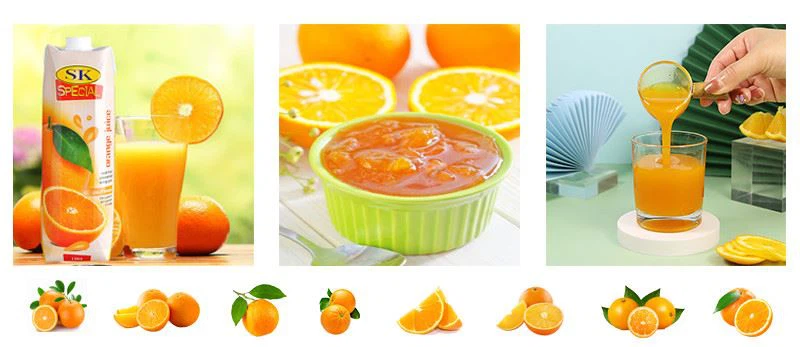
3. Different Types
Frozen Concentrated Orange Juice: These are commercial squeezed orange juice that is pasteurized and filtered before being evaporated under vacuum and heat. After most of the water is removed, it is concentrated and then stored as about 10 degrees Fahrenheit. With this process, vitamin C, essences, and oils are extracted and are added back after to restore flavor and nutrition.
Not from Concentrate: These are orange juice that is pasteurized and sold to consumers without having been concentrated. Most of the time, not from concentrate orange juices have reduced natural flavors. They also contain highly engineered additives. They also have different flavor formulas depending on what region they are made. This is because consumers in different parts of the world have different preferences when it comes to acidity, freshness, and sweetness.
Canned Orange Juice: Canned orange juice retains more vitamin C compared to bottled orange juice. However, canned products lose flavor when they are stored at room temperature for over 12 weeks. Before, when canned orange juice is fairly new to the market, the acidity of the juice caused it to have a metallic taste. But in 1931, a flash pasteurization process was developed by Dr. Philip Phillips. It is a process that eliminated this issue, which also increased the market for canned orange juice.
Freshly Squeezed / Unpasteurized Orange Juice: Freshly squeezed orange juice is unpasteurized, and it is the closest to consuming the orange itself. It is made by squeezing oranges and then bottling without adding any flavorings or additives. Freshly squeezed orange juice can last from 5 to 23 days, depending on storage temperature.
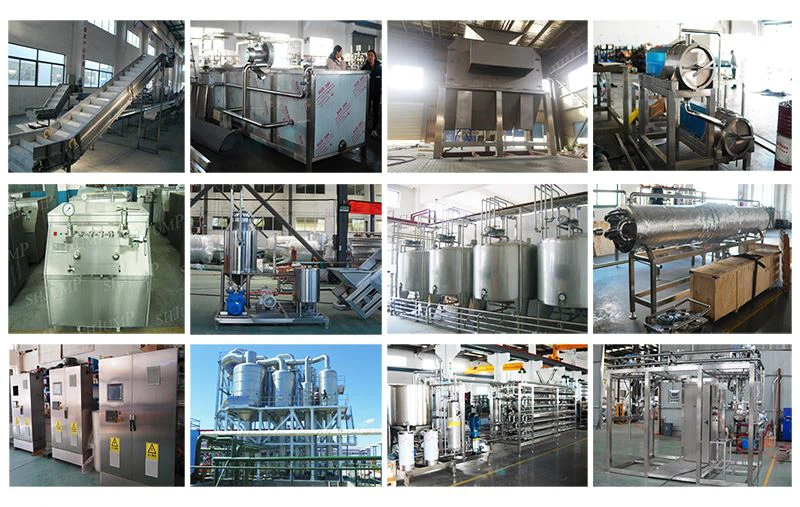
4. Related machines' pictures:
5. Process flow
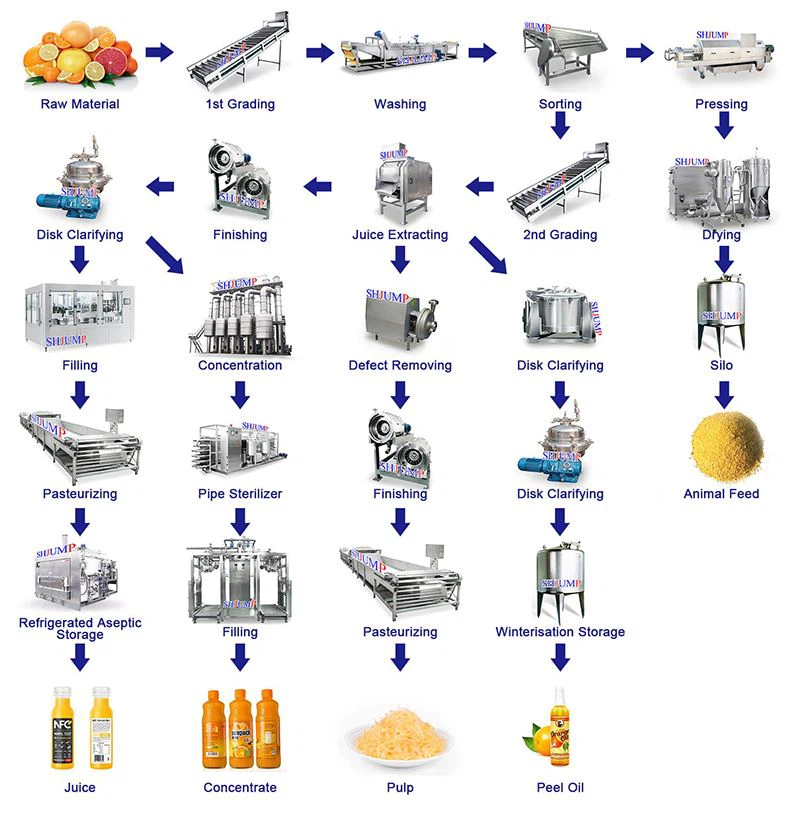
6. Some key process flows:
1.Harvesting/collection
Oranges are harvested from large groves. Some citrus growers are members of cooperative packing and marketing associations, while others are independent growers. When the mature fruit is ready to pick, a crew of pickers is sent in to pull the fruit off the trees. The collected fruit is sent to packing centers where it is boxed for sale as whole fruit, or sent to plants for juice processing. The oranges are generally shipped via truck to juice extraction facilities, where they are unloaded by a gravity feed onto a conveyor belt that transports the fruit to a storage bin.
2.Cleaning/Grading
The fruit must be inspected and graded before it can be used. An inspector takes a 39.7 lb (18 kg) sample to analyze in order to make sure the fruit meets maturity requirements for processing. The certified fruit is then transported along a conveyor belt where it is washed with a detergent as it passes over roller brushes. This process removes debris and dirt and reduces the number of microbes. The fruit is rinsed and dried. Graders remove bad fruit as it passes over the rollers and the remaining quality pieces are automatically segregated by size prior to extraction. Proper size is critical for the extraction process.
3.Extraction
Proper juice extraction is important to optimize the efficiency of the juice production process as well as the quality of the finished drink. The latter is true because oranges have thick peels, which contain bitter resins that must be carefully separated to avoid tainting the sweeter juice.
There are two automated extraction methods commonly used to orange juice extracting. The first places the fruit between two metal cups with sharpened metal tubes at their base. The upper cup descends and the fingers on each cup mesh to express the juice as the tubes cut holes in the top and bottom of the fruit. The fruit solids are compressed into the bottom tube between the two plugs of peel while the juice is forced out through perforations in the tube wall. At the same time, a water spray washes away the oil from the peel. This oil is reclaimed for later use.
The second type of extraction has the oranges cut in half before the juice is removed. The fruits are sliced as they pass by a stationary knife and the halves are then picked up by rubber suction cups and moved against plastic serrated reamers. The rotating reamers express the juice as the orange halves travel around the conveyor line.
Some of the peel oil may be removed prior to extraction by needles which prick the skin, thereby releasing the oil which is washed away. Modern extraction equipment of this type can slice, ream, and eject a peel in about 3 seconds.
4.Filtration
The extracted juice is filtered through a stainless steel screen before it is ready for the next stage. At this point, the juice can be chilled or concentrated if it is intended for a reconstituted beverage. If a NFC type, it may be pasteurized.
5.Concentration
Concentrated juice extract is approximately five times more concentrated than squeezed juice. Diluted with water, it is used to make frozen juice and many RTD beverages. Concentration is useful because it extends the shelf life of the juice and makes storage and shipping more economical. Juice is commonly concentrated with a piece of equipment known as a Thermally Accelerated Short-Time Evaporator, or TASTE for short. TASTE uses steam to heat the juice under vacuum and force water to be evaporated. Concentrated juice is discharged to a vacuum flash cooler, which reduces the product temperature to about 55.4° F (13° C). A newer concentration process requires minimal heat treatment and is used commercially in Japan. The pulp is separated from the juice by ultra-filtration and pasteurized. The clarified juice containing the volatile flavorings is concentrated at 50° F (10° C) by reverse osmosis and the concentrate and the pulp are recombined to produce the appropriate juice concentration. The flavor of this concentrate has been judged to be superior to what is commercially available in the United States and is close to fresh juice. Juice concentrate is then stored in refrigerated stainless steel bulk tanks until is ready to be packaged or reconstituted.
6.Reconstitution
When the juice processor is ready to prepare a commercial package for retail sale, concentrate is pulled from several storage batches and blended with water to achieve the desired sugar to acid ratio, color, and flavor. This step must be carefully controlled because during the concentration process much of the juice's flavor may be lost. Proper blending of juice concentrate and other flavor fractions is necessary to ensure the final juice product achieves a high quality flavor.
7.Pasteurization
Thanks to its low pH (about 4), orange juice has some natural protection from bacteria, yeast, and mold growth. However, pasteurization is still required to further retard spoilage. Pasteurization also inactivates certain enzymes which cause the pulp to separate from the juice, resulting in an aesthetically undesirably beverage. This enzyme related clarification is one of the reasons why fresh squeezed juice has a shelf life of only a few hours. Flash pasteurization minimizes flavor changes from heat treatment and is recommended for premium quality products. Several pasteurization methods are commercially used. One common method passes juice through a tube next to a plate heat exchanger, so the juice is heated without direct contact with the heating surface. Another method uses hot, pasteurized juice to preheat incoming unpasteurized juice. The preheated juice is further heated with steam or hot water to the pasteurization temperature. Typically, reaching a temperature of 185-201.2° F (85-94° C) for about 30 seconds is adequate to reduce the microbe count and prepare the juice for filling.
8.Packaging/filling
To ensure sterility, the pasteurized juice should be filled while still hot. Where possible, metal or glass bottles and cans can be preheated. Packaging which can not withstand high temperatures (e.g., aseptic, multilayer plastic juice boxes which don't require refrigeration) must be filled in a sterile environment. Instead of heat, hydrogen peroxide or another approved sterilizing agent may be used prior to filling. In any case, the empty packages are fed down a conveyor belt to liquid filling machinery, which is fed juice from bulk storage tanks. The filling head meters the precise amount of product into the container, and depending on the design of the package, it may immediately invert to sterilize the lid. After filling, the containers are cooled as fast as possible. Orange juice packaged in this manner has a shelf life of 6-8 months at room temperature.

Byproducts/Waste
By products from orange juice production come from the rind and pulp that is created as waste. Products made with these materials include dehydrated feed for livestock, pectin for use in making jellies, citric acid, essential oils, molasses, and candied peel. Certain fractions of orange oil (known as d-limonene), have excellent solvent properties and are sold for use in industrial cleaners.
7. Features
* The entire orange juice processing line can also deal with the same characteristics of the fruit, such as orange, lemon, etc..
* 3 models of the juice extractor can be chosen.
* According to the needs of customers can determine whether the need to separate the essential oil system.
* The final product can ensure the original nutrition and flavor.
* The advanced enzymatic hydrolysis separation system ensures the product quality and yield.
* According to the requirements of customers can choose to focus on the import and domestic.
* Full use of man-machine interface control, the production process is intuitive and easy control and operation, high automation, reduce labor costs.
* The whole production line includes automatic cleaning system.
8. History project site view :


Hot Tags: orange juice processing line, China, suppliers, manufacturers, factory, buy, price, for sale, made in China, strawberry juice making machine, strawberry pulp making machine, apple factory machine, pear juice making machine, strawberry puree making machine, pear plant machine