


NFC, Blended, and Concentrated Juice: What's the Difference?
Nov 04, 2026

Walk down a supermarket aisle and you'll often be puzzled by labels such as "100% pure juice," "NFC," and "from concentrate." For ordinary consumers, these differences affect taste and nutrition; for factories planning to build a juice production line, they directly determine the entire process route and equipment investment. This article explains the three mainstream types of juice on the market from both the consumer and the producer perspectives.
1. Consumer Side: What Really Differs Between the Three Types
NFC juice (Not From Concentrate) is made by washing, pressing, and sterilizing fresh fruit, then filling it directly into containers without concentrating or reconstituting with water. Its distinctive features are that no water or sugar is added (for pure NFC), giving a flavor closest to freshly squeezed juice. However, it requires cold-chain storage and transport, has a relatively short shelf life, and is the most expensive.
From Concentrate juice (FC) is first concentrated into concentrate at 65–70 Brix, then transported and stored to the destination, where water is added proportionally and the product is blended and reconstituted. Its advantages are low storage and transport costs, a long shelf life, and an affordable price, but some flavor and heat-sensitive nutrients are lost during the concentration and reconstitution processes.
Blended juice (juice drinks / compound juices) is made using concentrate, pulp, or NFC as the base, with water, sugar, acid, flavorings, and other ingredients added. Its juice content can be flexibly set (from 10% to 100%), the taste can be designed to order, and costs are controllable. It is the most common category on the market.
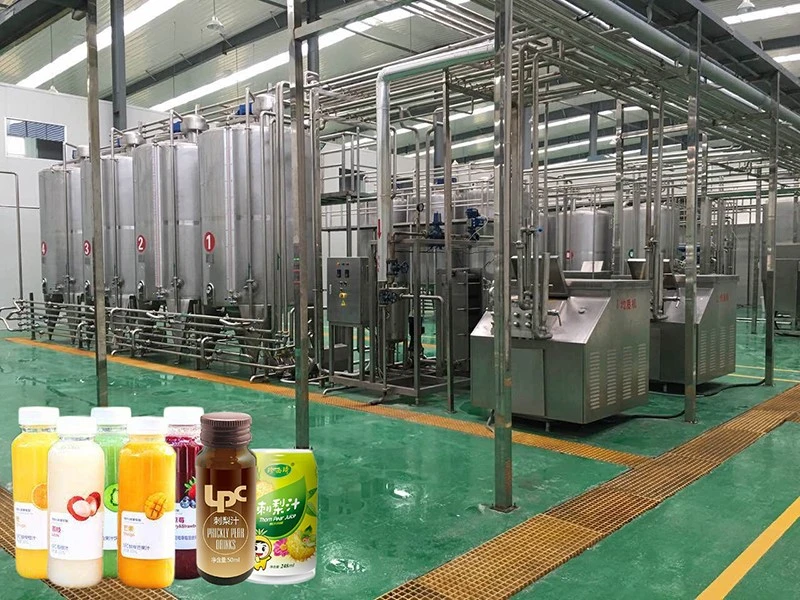
2. Production Side: Differences in Process Flow
NFC Juice Production Line
Fresh fruit → Washing → Sorting → Destoning/Crushing → Pulp refining → Belt press extraction → Horizontal centrifuge → Disc separator → Bulk pulp bagging/freezing → (ice breaking & thawing) → Automated blending → Vacuum deaeration → Homogenization → Filling → HPP sterilization (or sterilization before filling + post-pasteurization) → Air drying → Labeling & inkjet coding → Finished product
The core logic is no concentration and direct filling, pursuing the original, unadulterated flavor.
Concentrated Juice Production Line
Fresh fruit → Washing → Sorting → Crushing → Enzymolysis → Juice extraction → Enzyme inactivation → Clarification (ultrafiltration/resin adsorption) → Falling-film vacuum evaporation concentration → Cooling → Batch tank storage → Sheet filtration → Aseptic bulk bag filling
The core logic is evaporation and dehydration to raise the sugar content, concentrating the juice from 9–18 Brix to 70.3 ± 0.2 Brix. The condensed water from evaporation can also be recovered and reused as washing water or re-pressing water.
Blended Juice Production Line
Concentrate raw material extraction → Standardization system (sugar dissolving, blending) → Homogenization & deaeration → Sterilization → Hot-fill sealing → Post-filling sterilization → Tunnel cooling → Hot-air drying → Sleeve labeling & shrinking → Inkjet coding → Finished product
The core logic is to use concentrate/pulp as the base and add water and auxiliary ingredients for standardized blending-a typical dosing-and-blending process.
3. Production Side: Differences in Core Equipment
This is the area where the three types of juice differ the most, and the part that factories must pay the closest attention to during equipment selection:
|
Key Stage |
NFC Juice Line |
Concentrated Juice Line |
Blended Juice Line |
|
Pre-treatment |
Washing machine, sorting table, destoner/crusher, double-pass pulper, belt press extractor, horizontal centrifuge, disc separator |
Washing machine, crusher, enzymolysis tank, belt/twin-screw press extractor, horizontal centrifuge, disc separator |
Usually no pre-treatment needed; concentrate/pulp is purchased directly as raw material |
|
Core equipment |
Vacuum deaerator, high-pressure homogenizer (no concentration stage) |
Falling-film vacuum evaporation concentration system (triple-effect four-stage / four-effect six-stage), evaporation capacity from 2,600 L/H to 22,000 L/H |
High-speed sugar dissolving tank, blending tank (2,000–15,000 L), duplex filter, vacuum deaerator, high-pressure homogenizer |
|
Sterilization & filling |
UHT or HPP sterilization + aseptic/conventional filling |
UHT ultra-high-temperature instant sterilization + aseptic filling machine (bulk bags) |
Tubular/tube sterilization machine + hot-fill/aseptic filling |
|
Downstream stages |
Air drying, labeling, inkjet coding |
Barrel conveying system, aseptic filling |
Post-filling sterilizer, tunnel cooling machine, hot-air drying, sleeve labeling & shrinking |
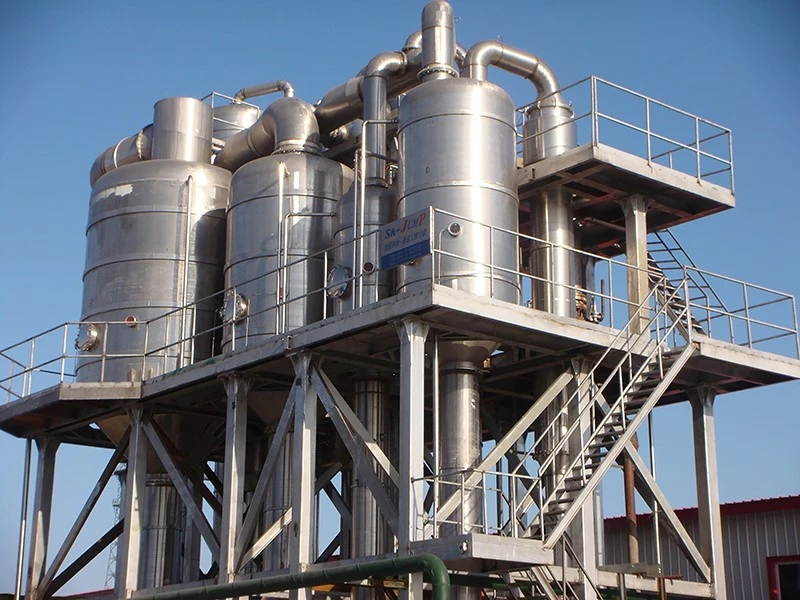
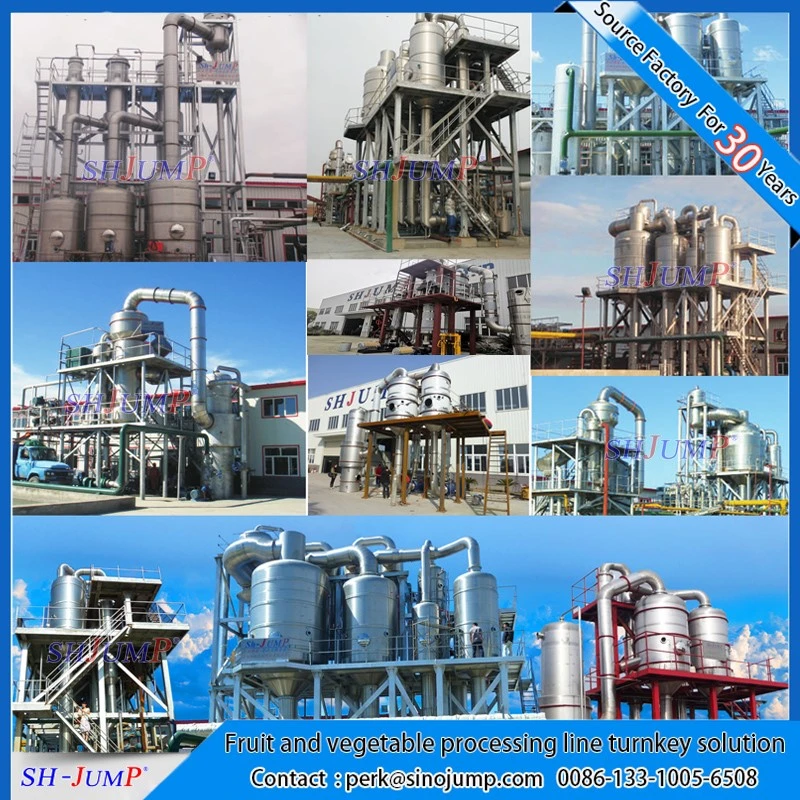
Among these, the falling-film vacuum evaporator is the absolute core of the concentrated juice line. It performs continuous low-temperature evaporation under vacuum, and the product stays in each effect for only a few seconds. It is especially suitable for heat-sensitive materials, effectively protecting the juice's nutrients, and the evaporator starts up quickly and is easy to switch over and clean.
This type of equipment can be designed as single-effect, double-effect, and up to four-effect six-stage units by evaporation capacity, and it accounts for the largest share of investment in a concentration line.
4. Equipment Selection Guide for Market Customers
Customers pursuing the NFC/cold-press fresh-squeezed route: Suitable for factories with a stable supply of fresh fruit that target premium refrigerated channels (convenience store cold cabinets, high-end supermarkets). Core investment goes to pre-treatment (pressing, centrifuging, separating) + sterilization (HPP or UHT) + aseptic/cold-chain filling. No expensive concentration system is needed, but frozen pulp storage and thawing must be configured.
Customers pursuing the concentrated juice export or bulk-package raw material route: Suitable for factories rich in producing-region resources that focus on export or on supplying base materials to downstream beverage plants. Core investment is the falling-film vacuum evaporation concentration system, whose equipment is high-priced (a triple-effect four-stage system can reach several million yuan), but the product's storage and transport costs are low, shelf life is long, and economies of scale are significant.
Customers pursuing the blended/compound juice drink route: Suitable for factories making end-product bottled beverages, with rich product lines, that want to start production quickly. This line skips pre-treatment and starts directly from concentrate/pulp blending. Core investment is in blending tanks, sugar dissolving tanks, deaeration & homogenization, sterilization & filling, and downstream packaging. Overall investment is relatively controllable and product formula flexibility is high.
If a factory wants "one line, multiple uses": consider purchasing a complete line designed with extensibility. By adjusting process parameters, one set of equipment can switch between producing multiple materials and product forms, improving equipment utilization and achieving product diversification.
Our company supports turnkey complete-line supply, delivering everything from pre-treatment to filling and packaging in one stop, and can provide non-standard customized solutions based on the customer's product positioning.
Learn more about juice blending production lines
Want to Learn More?
Contact us now for a detailed equipment list, transparent pricing, and a free bilingual (Chinese-English) process flow chart to help your technical team clearly plan this super production line !
WeChat: 13310056502
WhatsApp: 86 13310056502
Email: perk@sinojump.com


