Roller Brush Washing Machine——Detailed Overview of Industrial Pre-processing Equipment for Washing and Peeling Fruits and Vegetables
Sep 20, 2026
Equipment Overview
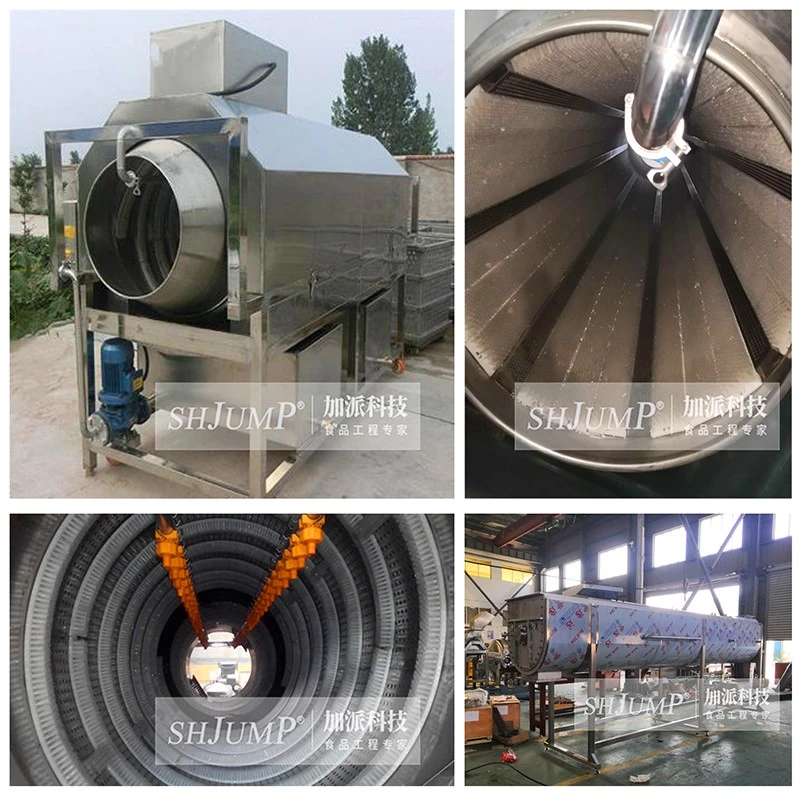
The fully automatic roller brush washing machine (also known as a brush-spray washer) is a core unit for the initial pretreatment stage of fruit and vegetable processing lines. Positioned after the initial bubble wash or infeed elevation-and prior to sorting/conveying or crushing/pulping-it performs intensive brush cleaning and offers optional light peeling capabilities. Designed for juice plants, canning facilities, purée processors, freeze-dried snack manufacturers, and fresh fruit sorting/export centers, this machine addresses three major industry pain points: incomplete cleaning of root vegetables and produce with adhering soil (which leads to excessive foreign matter in downstream processes); the high labor intensity and low efficiency of manual scrubbing, which cannot meet mass production demands; and the need to combine gentle peeling with washing, thereby reducing the capital investment required for separate peeling equipment. This unit is one of the most versatile pieces of pretreatment equipment in our fruit and vegetable processing portfolio and serves as a flagship model for industrial vegetable washing in root crop processing applications.
Bill of Materials for Compatible Processed Materials
For produce requiring light peeling (e.g., potatoes, taro, carrots, ginger): The use of rigid nylon brush rollers enables simultaneous scrubbing and light peeling-offering dual functionality in a single machine and eliminating the need for separate steam or lye peeling equipment.
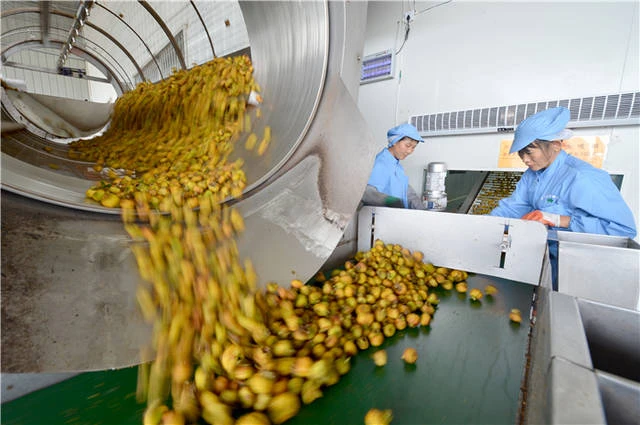
·For high-fiber or hairy produce (e.g., dates, passion fruit, sea buckthorn): The rotating brush rollers directly grip and brush away surface fibers or hairs, effectively solving the industry-wide challenge of removing fibrous or hair-like surface attachments.
The entire machine can be customized based on the specific fruit or vegetable variety. Structural parameters-such as brush roller rigidity, bristle material (nylon, soft, or wavy), spray pressure, roller spacing density, and discharge baffle adjustment mechanisms-are tailored to ensure optimal cleaning and peeling results for different types of produce.
Operating Principle of the Unit
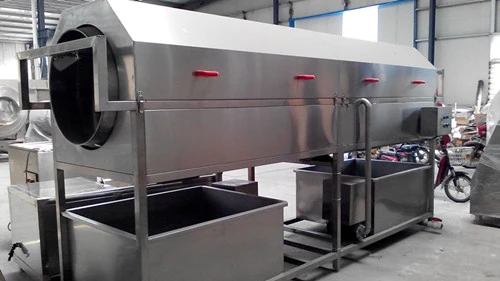
This Roller Brush Washing Machine operates via a continuous assembly-line process, broken down into the following stages:
Infeed Conveying: Raw materials are evenly fed into the washing tank via an upstream elevator or a transition conveyor following a bubble-washing stage. Upon entry, the materials land on a conveying track formed by multiple rows of rotating brush rollers.
Rotary Brush Scrubbing: The tank is equipped with a dense array of nylon brush rollers (made from food-grade bristles that are flexible and resistant to matting), driven by a motor through a gear reduction system. Propelled by the rollers and the resulting friction, the materials tumble 360° as they advance; adjacent rollers operate independently in an interlaced pattern, ensuring full contact between the bristles and the material surfaces to effectively remove mud, dirt, hair, debris, and pesticide residues.
High-Pressure Spray Rinsing: Multiple sets of high-pressure spray nozzles are positioned above the brush rollers, continuously spraying clean water during the scrubbing process. This immediately washes away dislodged contaminants, preventing cross-contamination between materials while keeping the brushes clean.
Buffer Transition and Discharge: Driven continuously forward by the brush rollers, the washed materials reach the discharge end. An adjustable baffle (or an automatic discharge gate on certain models) is located at the outlet; when opened, the materials pass smoothly via a guide plate or transition chute to the next processing stage. Excess water drains naturally in the discharge section.
Three Core Competitive Advantages
Advantages in Minimizing Raw Material Loss
The system employs flexible brush friction rather than harsh mechanical compression for peeling and washing; materials make uniform contact with the brushes while tumbling, eliminating damage from hard impacts. For produce requiring gentle peeling-such as potatoes and carrots-the peeling depth can be precisely controlled by selecting the appropriate brush bristle hardness and adjusting the washing duration (via variable frequency drive); this results in lower peeling loss rates compared to traditional caustic or steam peeling methods. When using soft, wavy-bristle brushes for thin-skinned fruits, the skin integrity rate exceeds 95%; industry data indicates that brush washing reduces material loss by 2–4 percentage points compared to mechanical drum-style washing.
Advantages in Food Compliance and Quality
The entire machine is constructed from SUS304 food-grade stainless steel (upgradable to SUS316L); components in contact with the product feature a sanitary design free of dead zones, with smooth, easy-to-clean welds. Food-grade nylon brushes are used-offering temperature and corrosion resistance without bristle shedding-ensuring compliance with safety standards for food-contact materials. The equipment meets EHEDG sanitary design guidelines as well as EU food export certification and FDA market access standards. Equipped with CIP (Clean-in-Place) ports, the system allows for automated, periodic internal cleaning, effectively mitigating risks associated with food safety inspections.
Long-term Operational and Maintenance Cost Advantages
· Easy disassembly and cleaning: The spray piping features a quick-release design, and the brush rollers utilize a slide-out mounting system, allowing a single person to handle daily maintenance and cleaning.
· Minimal wear parts: The core moving components consist only of the gear motor and brush rollers; the brush rollers have a service life of 6–12 months (depending on the hardness of the processed material), ensuring low replacement costs and quick, easy replacement.
· Low water and power consumption: The high-pressure spray pump has a power rating of only 0.75–2.2 kW (depending on the model), and the integrated water circulation and filtration system significantly reduces water consumption compared to continuous-flow washing methods; the total installed power is just 1.5–6 kW, keeping energy costs manageable.
· Single-person operation: During operation, the equipment requires only periodic checks at the infeed and discharge ends rather than a dedicated operator, thereby reducing labor requirements.
Standardized Technical Parameter Table
|
Parameter |
Specification |
|
Standard processing capacity range |
0.5 T/H ~ 15 T/H (varies by model, customizable) |
|
Compatible material size |
Fruit & vegetable raw materials, Ø10–150 mm (adjustable brush roller spacing available) |
|
Machine construction material |
SUS304 food-grade stainless steel (upgradable to SUS316L) |
|
Total installed motor power |
1.5–6 KW (drive motor + spray pump, depends on model & capacity) |
|
Applicable voltage |
380V / 50Hz three-phase (adjustable per export destination) |
|
Overall dimensions (reference) |
From 1100×530×800 mm (0.5 T/H level) to 4500×800×2200 mm (10 T/H level); all sizes customizable |
|
Control method |
Electric control cabinet one-touch start/stop / variable-frequency speed control (optional) / whole-line interlock (optional) |
|
Safety protection configuration |
Overload protection, emergency stop button, leakage protection, anti-dry-burn level control |
|
Utility requirements (water & air) |
Industrial water supply connection DN25~DN32; no compressed air supply required |
The above specifications apply to standard models; however, specific production capacity, brush roller material, physical dimensions, and electrical control configurations can be customized. Tailored solutions can be designed based on the specific characteristics of the materials and the factory's workshop layout.
Production Line Integration and Adaptation Solutions

Upstream integrated standalone units:
·Bubble washing machine: Serves as the preliminary washing stage to remove the bulk of surface soil, sediment, and floating impurities before the product enters the brush washer for deep cleaning; this creates a two-stage (preliminary + thorough) cleaning process that ensures higher cleaning efficiency.
·Low-profile elevator/infeed conveyor: Lifts raw materials to the brush washer's inlet, facilitating seamless material transfer.
Downstream processing equipment:
·Chain-plate sorting conveyor platform (for manual sorting or optical color sorting)
·Fruit crusher / de-pitter / juice extractor
·Slicer / dicer / segment cutter
·Blanching machine (for processes such as tomato peeling)
Available complete production lines
·Citrus/Orange Whole-Fruit Juicing Line: Bubble washing → Brush washing → Sorting → Juicing → Refining → Pasteurization → Filling
·Carrot/Root Vegetable Processing Line: Elevating → Bubble washing → Drum brush washing & peeling → Sorting → Crushing/Slicing → Drying/Juicing
·Mango Purée/NFC Juice Line: Bubble washing → Brush washing → Heat treatment → Peeling & destoning → Pulping → Pasteurization → Aseptic filling
·Potato/Sweet Potato Deep-Processing Line: Brush washing & light peeling → Slicing/Stripping → Blanching → IQF freezing/Frying/Drying
·Fresh Fruit Pre-treatment Line (for Export/Grading): Bubble washing → Brush washing → Air drying → Waxing/Coating → Grading & sorting → Packaging
·Canned Peach/Apple Processing Line: Elevating → Brush washing → Halving & destoning → Pre-cooking → Canning → Sterilization

We provide turnkey production line solutions, offering a comprehensive one-stop service that covers everything from equipment selection and workshop layout to installation and commissioning.
Want to learn more? 📩 Contact us today for a detailed equipment list, a transparent quote, and a complimentary bilingual (Chinese-English) process flow chart to help your technical team clearly plan this high-capacity production line!
WeChat: 13310056502
WhatsApp: 86 13310056502
Email: perk@sinojump.com