Coconut Milk Production Line | Fully Integrated from Raw Coconut Feeding to Filling
Aug 13, 2026
From Raw Coconuts To Finished Coconut Milk With Minimal Manual Intervention
1. Coconuts piling up by the ton while workers spend all day dehusking them by hand?
You work from morning to night, yet the output still falls short?
2. Your freshly extracted coconut milk starts separating after just a couple of days?
Water on top, sediment at the bottom, and customers asking, "Is this coconut milk or a separation experiment?"
3. Sterilization temperatures depend on an experienced operator's judgment?
The product is rich today and thin tomorrow, and quality consistency feels like a roller coaster. When a large order comes in, you hesitate to take it because you're not sure you can keep up with the required quality and output.

Today, let's take a closer look at what we call the "Transformer" of coconut milk processing - Shanghai Jump Machinery's fully Automatic Coconut Milk Production Line .
From a whole coconut with its husk still on to a smooth, creamy finished coconut milk, the entire process is designed for automation, standardization, and large-scale production.
With the right configuration, just 1–2 operators can manage the entire production line, helping you move beyond small-scale manual processing and into more efficient industrial production.
Coconut Milk Production Process
Step 1: Coconut Dehusking
The first thing that happens when coconuts arrive at the factory is simple: the brown outer husk comes off.
Our semi-automatic coconut dehusking machine features a roller-and-toothed-wheel design. Each coconut takes only 3–5 seconds to process. With six machines operating simultaneously, the system can handle thousands of coconuts per hour, delivering efficiency far beyond manual dehusking.
Once the husk has been removed, the clean coconuts are transferred to the next processing stage through the coconut collection conveyor.
And the husk doesn't have to go to waste. Coconut husk can be further processed into coir mattresses, sofa filling materials, horticultural substrates, and other products - meaning even the processing by-products can create additional value.
Step 2: Vacuum Coconut Water Extraction - Recover Every Drop
Next comes one of our key pieces of equipment: the vacuum semi-automatic coconut water extraction machine.
The machine features a six-station extraction system. The upper pneumatic cylinder is connected to a top cone that securely holds the coconut in place, while the lower pneumatic cylinder is connected to a suction needle that precisely penetrates the coconut from underneath.
Under vacuum pressure, the coconut water is extracted through the suction system and transferred through a liquid suction hose into a collection tank.
A pressure sensor is installed on the movement shaft of the upper cone and connected to the PLC control system. If the pressure becomes too high, the system automatically adjusts it to help prevent the coconut from being crushed while ensuring efficient coconut water recovery.
The coconut water recovery rate can reach more than 98%.
Could manual processing really deliver this level of consistency?
Step 3: Rotary Coconut Peeling
After the coconut water has been extracted, the coconuts are transferred to the rotary coconut peeling machine.
With a capacity of 300–600 coconuts per hour, the machine uses a dual-blade automatic peeling system. A concealed pneumatic cylinder securely holds the coconut in place, while the blade automatically moves up and down to remove the outer skin.
No secondary manual operation is required.
The machine also features a high-performance waterproof design. After peeling, the clean white coconut meat is transferred by conveyor to the next processing stage.
Crushing, Pressing & Grinding System - Where the Coconut Becomes Milk
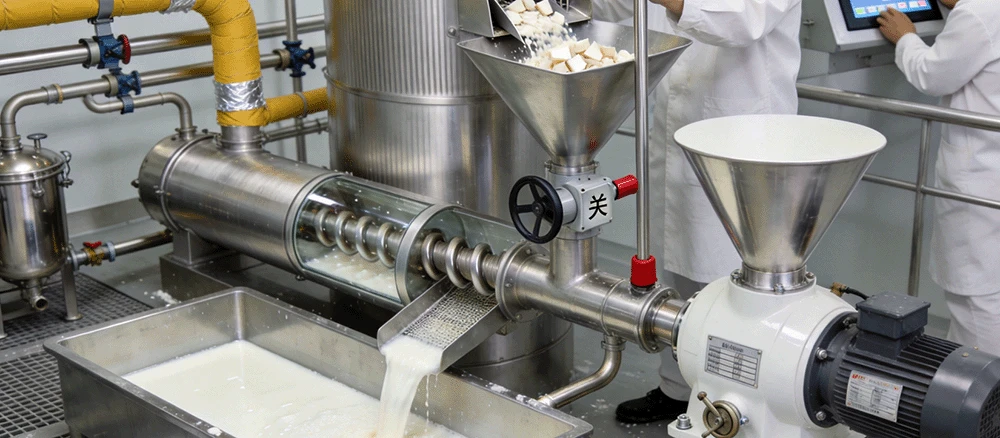
This is the core processing section where the coconut meat is crushed, pressed, and ground to produce coconut milk.
Step 4: Dual-Stage Filtration
After the coconut milk is initially extracted through the screw juice extractor, it passes through a dual-stage filtration system for further filtration.
The first stage uses a 120-mesh screen for coarse filtration, followed by a 180-mesh screen for fine filtration.
The two-stage filtration process helps remove unwanted fibers and solid particles, producing a cleaner and smoother coconut milk base for the next processing stages.
Step 5: Precise Formulation and Blending
The filtered coconut milk enters the blending tank, where ingredients such as sugar, emulsifiers, and stabilizers are thoroughly mixed into the product.
The sugar is first dissolved in a jacketed cooking tank to produce a 50% sugar syrup. The syrup is then filtered before being added to the coconut milk.
The formulation is as follows:
| Coconut water | 10% |
| 50% sugar syrup | 18% |
| Salt | 0.05% |
| Emulsifier | 0.20% |
| Stabilizer | as required |
| Citric acid: adjust the pH to | 6–7 |
| Processing temperature: approximately | 80°C |
The emulsifier is formulated with: 60% monoglycerides + 10% sorbitan fatty acid esters + 30% polyoxyethylene fatty acid esters
- An appropriate amount of xanthan gum is added as the stabilizer.
- The exact formulation can be adjusted according to the product requirements.
With precise ingredient addition and controlled processing conditions, each batch can be produced to a consistent formulation - eliminating the problem of having a rich product one day and a thin product the next.
Step 6: High-Pressure Homogenization
The high-pressure homogenizer is one of the key pieces of equipment for achieving a smooth and stable coconut milk texture.
The system uses a two-stage homogenization process:
- First-stage homogenization pressure: 23 MPa
- Second-stage homogenization pressure: 30 MPa
- Homogenization temperature: approximately 80°C
At pressures of up to 30 MPa, the fat globules and suspended particles in the coconut milk are broken down into much smaller sizes and more evenly dispersed throughout the liquid.
This helps improve emulsion stability, texture, mouthfeel, and resistance to separation.
The result is a smoother, creamier coconut milk with a more uniform and stable texture.
No more worrying about separation and sedimentation. With high-pressure homogenization, you can achieve a smoother and more consistent finished product.
Step 7: 121°C Sterilization - Consistent Processing for Every Batch
For the sterilization stage, we use Jump's patented tubular sterilization machine.
The sterilization temperature is set at 121°C, with a holding time of 15 minutes. During production, the temperature fluctuation is controlled within ±1°C.
Precise temperature control helps ensure consistent sterilization conditions from batch to batch.
The sterilization system uses product-to-product heat exchange for heating and cooling, reducing energy consumption by approximately 30% compared with similar sterilization equipment.
The system can also be equipped with internationally recognized components, including:
Spirax Sarco steam valves - UK
Siemens PLC and touchscreen control system - Germany
NETZSCH product pumps - Germany
These internationally recognized components are used for key parts of the system to support reliable operation and stable process control.
Step 8: Filling & Sealing - Ready for the Market
After sterilization, the coconut milk is transferred through sanitary pipelines to the aseptic filling system.
Under the protection of a Class 100 laminar-flow hood, sterile air continuously flows through the filling area to maintain a controlled hygienic environment.
The filling nozzles accurately dispense the coconut milk into sanitized PET bottles or metal cans, followed by sealing and capping.
The finished products then pass through the following stages:
Date & Batch Coding
1
>>
Labeling
2
>>
Carton Packing
3
>>
Case Sealing
4
>>
Finished Product Conveying
5
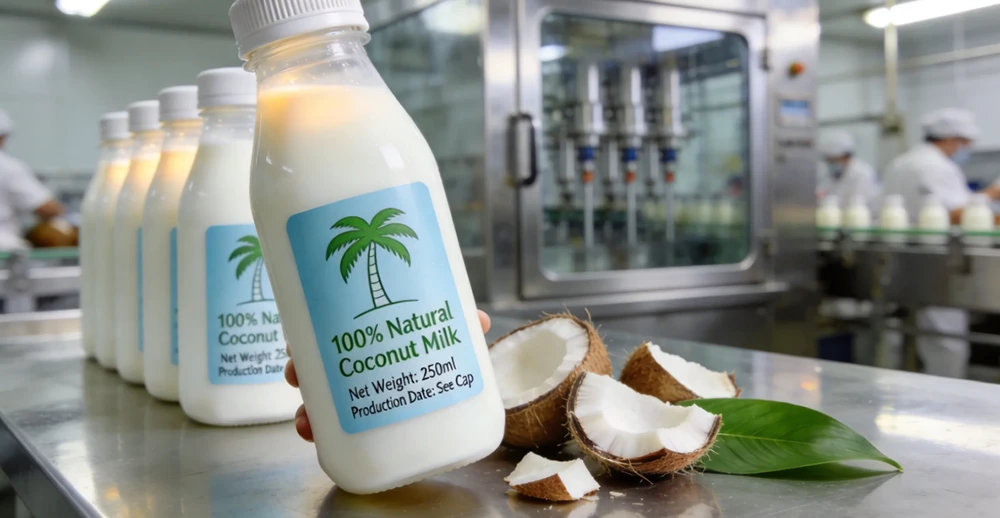
The automatic coding machine prints the production date and batch number. The labeling machine applies the product labels, while the case-packing and sealing equipment completes the final packaging process.
The finished coconut milk products are then ready for shipment to customers and markets around the world.
Why Choose Jump Machinery?
6Reasons to Choose Our Coconut Milk Production Line
1. Flexible Production Capacity - Produce at the Scale You Need
Our production lines cover capacities from 500 kg/h to 20 t/h.
Whether you are starting with small-batch premium coconut milk production or already operating at scale and looking to expand, we can provide a production line configured around your required capacity.
2. Complete Turnkey Solution - One Production Line, One Supplier
From:
Coconut Feeding → Dehusking → Coconut Water Extraction → Peeling → Crushing → Pressing & Grinding → Filtration → Blending → Homogenization → Deaeration → Sterilization → Filling → Labeling → Case Packing
Jump provides an integrated solution covering the entire production process.
You only need to feed the coconuts into the line - the rest of the process is handled by the production system.
3. One Production Line, Multiple Product Possibilities
One production line can be configured to produce a variety of coconut-based products, including:
Full-Fat Coconut Milk: 5%–20% fat, a classic product with stable market demand
Low-Fat Coconut Milk: A lighter option for health-conscious consumers
Concentrated Coconut Milk: Suitable for cooking, desserts, and foodservice applications
Fermented Coconut Milk: Suitable for plant-based yogurt and other fermented products
Coconut Flakes & Coconut Powder & Coconut Oil & Coconut Water
One production line, multiple product opportunities.
4. Food-Grade SUS304 Stainless Steel - Built for Food Processing
All product-contact parts are made from food-grade SUS304 stainless steel.
The specified material thickness is ≥2 mm, providing corrosion resistance, durability, and suitability for food processing applications.
5. Fully Automatic Control - One to Two Operators Can Manage the Line
The production line is equipped with a Siemens PLC control system and touchscreen interface.
With centralized automatic control, the system can coordinate the various processing stages from raw material feeding through to finished product output.
Depending on the production line configuration, 1–2 operators can manage the entire line, helping reduce labor requirements and operating costs.
6. Automatic CIP Cleaning - Easier Cleaning, Better Hygiene
The production line can be equipped with an automatic CIP (Clean-in-Place) system.
Acid cleaning, alkaline cleaning, and hot-water rinsing can all be completed automatically.
The sanitary design of the pipelines, joints, and connections helps maintain hygienic conditions during production.
No need to dismantle the equipment for routine cleaning. No need for manual scrubbing. Clean the system and get ready for the next production run.
Customer Projects - Our Equipment Is Running Worldwide
Shanghai Jump Machinery has been deeply involved in the food and beverage processing equipment industry for nearly 20 years.
Since 2008, we have provided more than a hundred complete production line solutions to customers in dozens of countries and regions around the world.
Our project experience includes:

Vietnam
5 T/H coconut flake processing line with pressing system
Indonesia
3 T/H coconut water sterilization and filling system
California & USA
Bottle inversion sterilization machine
Thailand
Coconut water and coconut milk production line
Our equipment is running in coconut processing plants around the world, backed by real project experience in the field.
We are not just supplying individual machines. We provide complete processing solutions designed for real production environments.
Don't Let Your Competitors Get Ahead
While you are still relying on manual coconut processing, your competitors may already be using fully automatic production lines to achieve ton-scale production with lower labor requirements.
While your products are still facing customer complaints because of separation, other manufacturers are using high-pressure homogenization to achieve a smoother, more consistent coconut milk texture.
And while labor costs and processing losses continue to put pressure on your margins, automation and intelligent control can help reduce manual intervention and improve production efficiency.
In business, falling behind can mean losing ground. If you are planning to upgrade your coconut milk production, now is the time to take the next step.
Contact Us To Build Your Coconut Milk Production Line
Shanghai Jump Machinery Technology Co., Ltd.
Factory Address: No. 58 Pengqing Road, Huaqiao Town, Kunshan, Jiangsu, China
What Can You Get from Jump?
1. A Customized Coconut Milk Production Line Proposal & Detailed Quotation
We will develop a production line solution based on your required production capacity and provide you with a detailed quotation.
2. An Opportunity to Visit Our Factory
Visit our factory and see the equipment in operation firsthand. Inspect the production line and see the SUS304 stainless-steel construction for yourself.
3. A Production Test Using Your Own Coconuts
Bring your own coconut raw materials to our factory for a production test. See how the equipment performs, evaluate the extraction results, and assess the finished product quality before making your investment.
Ready to Discuss Your Coconut Milk Production Project?
WhatsApp: +86 133 1005 6505
Jump Machinery - Helping You Get More Value from Every Coconut.
Shanghai Jump Machinery Technology Co., Ltd. has specialized in food and beverage processing equipment for nearly 20 years. Since 2008, we have provided complete production line solutions to customers in dozens of countries and regions, helping bring Chinese food processing equipment to markets around the world.